What our health signals may reveal between doctor visits, even when we think we feel fine.
“What happens in the dark comes to light.”
I want wearables to help bring more of our health into that light, to expose those monsters in the dark. The hours between doctor visits, when changes can go unnoticed. The nights nobody asks about because we say we slept “fine.” The changes in heart rate, sleep and activity that might otherwise be left out of the next conversation with our care team. A watch, ring or sensor can collect pieces of that story while we're busy living it. NIH on wearable health signals
What interests me is what those pieces can show over time. A reading today has a place. So does knowing whether something has been changing for days or weeks. That's where wearables get my attention, and where this gets personal. I've spent more than 30 years afraid to shine a light into those dark spaces and look at my own numbers. I understand the appeal of leaving the light off a little too well. But believe me, if there are monsters lurking in the dark, I'd rather know they're there so I can do something about them.
I know what fear can keep in the dark
I found out I had hypertension in my early 20s while serving in the Air Force. I was strong, in shape, and felt fine. Some say I'm still fine 💪🏾😉. I looked like the last person who ought to be worrying about blood pressure. Apparently, my blood vessels had not been briefed on how healthy I looked.
Where I'm from, we call hypertension, or high blood pressure, “preshu.” And the warning is simple: “Preshu bust pipes.” When those “pipes” are inside your body, that warning gets personal. I've known people who died too soon, so that little saying carries weight. A reading can start to feel like somebody is about to tell you how your story ends. I could work hard, get stronger and push through things. I couldn't muscle my way out of hypertension. That pissed me off then. It still does.
I take my medication. I consider passing on that second… I mean third glass of red wine. 🍷😜 I understand why this matters. I also don't check my blood pressure with an FDA cleared cuff as consistently as I should. I hesitate to shine a light into my own dark space because I'm afraid of what I might see. I know burying my head in the sand or hiding under a pillow won't make it go away. If I told you I routinely reach for my handy dandy cuff, that would be a lie.
Ask me whether I want to check it, and part of me still says, “Oh hell to the naw.” I don't want to see a number I can't talk myself out of knowing. I've worked hard for this life. The idea that something quiet, lurking in the dark, could “bust a pipe” and take it away makes me angry. Underneath that, I'm scared. Terrified is closer to the truth.
Avoiding the reading gives me relief without giving me protection. My body still has to deal with whatever my blood pressure is doing. Hypertension often has no physical symptoms. Feeling fine, staying comfortably ignorant or ignoring reality won't tell me what my blood pressure is doing. That's my personal example of why waiting to feel something can leave us in the dark. It is also why a good sleep score cannot replace the blood pressure measurement I still need to take. FDA safety guidance
My blood pressure is one part of a much bigger story
Depending on the device and feature, wearables can collect or estimate heart rate, sleep and activity. Other wearable medical devices, such as continuous glucose monitors, have different jobs. These are different tools with different capabilities. What a particular model can do, how well it does it and where a feature is available all matter. NIH on wearable tools and research; HHS on monitoring devices.
A useful question reaches beyond “What did it say this morning?” What has been happening over the last few weeks? Is the pattern different from what's usual for this person? Has a change persisted? What was going on at the time? That is longitudinal data: information collected repeatedly over time, so we can examine the course of things rather than asking one measurement to tell the whole story.
Imagine someone whose recorded sleep has been getting shorter, whose usual activity has dropped and whose resting heart rate has shifted. That's an example, not something I'm claiming happened to me. Those observations don't identify a disease. They give the person and care team a more specific conversation to have than “I guess I've been a little off lately.” That record helps shine a light between visits, when the professional “ghostbusters” aren't in the room.
We still have to ask whether the measurements are trustworthy. Was the device worn consistently? Did the person change their routine? Is there missing data? Has the sensor or software changed? Several numbers moving together don't automatically add up to a diagnosis. More questionable data can give us a more elaborate way to be wrong.
But dismissing useful patterns because they aren't a diagnosis throws away a different kind of value. I want a record that can help me describe what has changed, when it started and whether it kept happening. When somebody asks, “How have you been?” I know how easily “fine” comes out of my mouth. I'd like that conversation to have more to work with than my memory and my talent for avoiding the subject.
That is the connection I mean when I talk about Signal Before Symptom™. Can we recognize a meaningful change, check it properly and start the right conversation before an obvious symptom forces our attention? I want that chance before the monster sneaks up and snatches our health. That opportunity has to be established for the particular device, condition and use. It isn't a promise that every wearable will predict illness. It is a reason to investigate useful signals instead of requiring a person to feel sick before we take an interest.
Keep the light on between visits
My health doesn't run on the clinic's appointment schedule. My body doesn't stop changing when I leave the clinic. Neither does anybody else's. The days between appointments are when we work, sleep, worry, take medication, exercise or don't, and try to keep a life together. Wearables can give us a record of parts of that everyday life. Used appropriately, that information can help support care between visits. HHS on remote patient monitoring
Some features collect readings in the background; others require a deliberate measurement or action. Batteries die. Devices come off. Data can be missing or wrong. “Keep the light on” means working toward better visibility over time, with those limits understood. It doesn't mean a device sees everything or that a clinician is watching every minute.
I think of the wearable as a sentry with a flashlight, garlic, holy water, and a brand new cross from Home Goods. I still like that sentry. He came prepared. Give him a job he can actually do, though. He doesn't get promoted to blood pressure monitor because I don't like the cuff. The exact medical function needs appropriate authorization and evidence; a wellness estimate doesn't inherit those credentials because it appears beside a medical feature. FDA guidance on unauthorized BP features
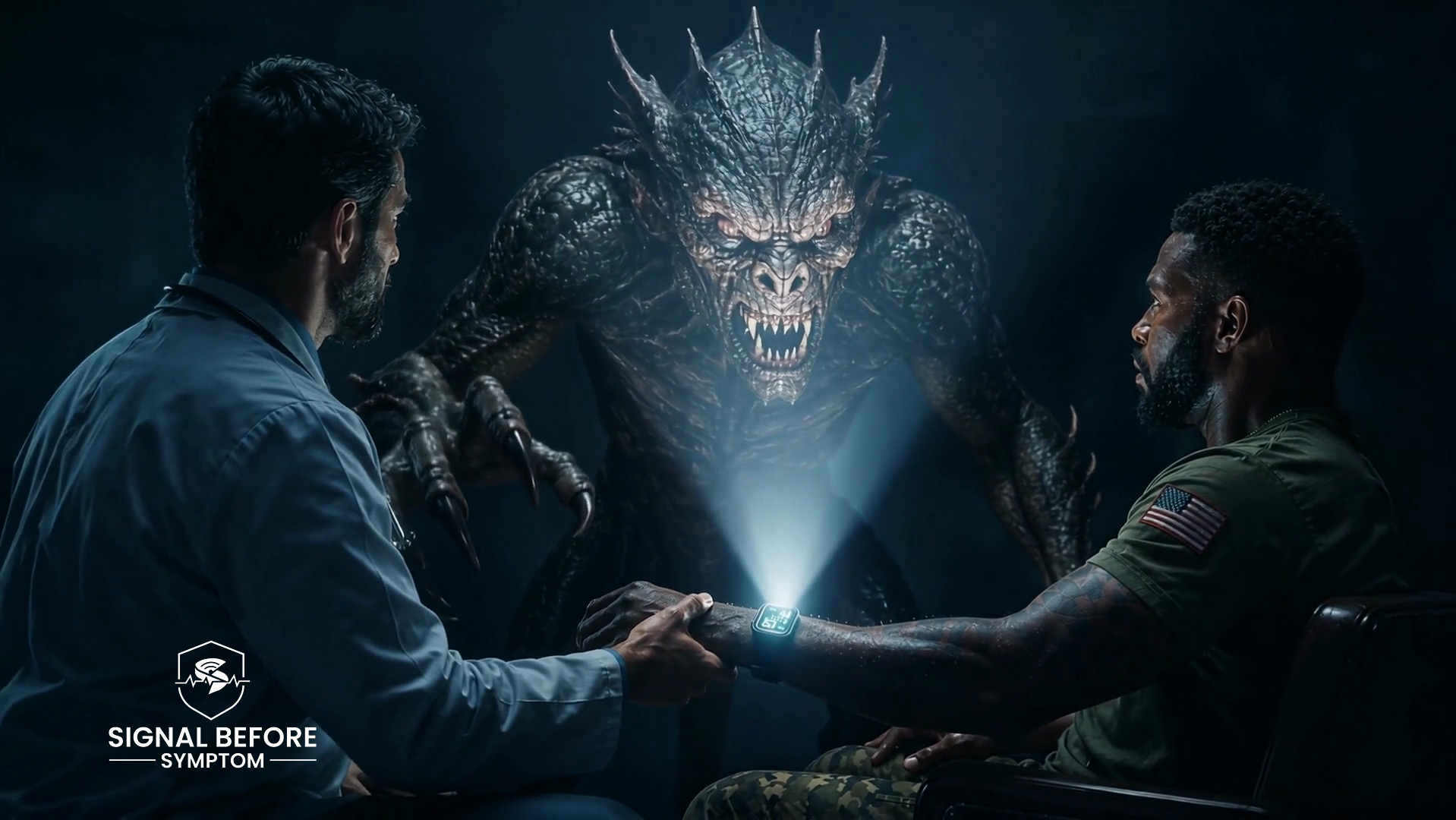
The picture with this story makes that light literal. A Veteran. A clinician holding his hand. A watch exposing a creature in the darkness. The watch beam and creature are editorial fiction, not a real device feature. The real work is getting a useful observation out of the dark and into a conversation where somebody knows what to do with it. Giving me a better view of the monster and leaving me sitting there scared would be a hell of an unfinished job.
Collecting data needs to lead somewhere
There are two different jobs here: a device collecting information, and a care team monitoring a person under an agreed plan. Buying the device doesn't automatically arrange the second job. If nobody has agreed to review the information, a rising line on a screen may just become one more thing for an anxious Veteran to stare at.
VA already has a Remote Patient Monitoring program that supports Veterans with clinical needs involving conditions such as hypertension, diabetes, heart failure and COPD. Evaluation and enrollment connect the Veteran with equipment and a Care Coordinator. VA describes monitoring during normal business hours, Monday through Friday. That is an existing place to ask about structured support, not a promise of emergency surveillance. It does not mean every consumer wearable is part of that program or that every Veteran qualifies. VA Remote Patient Monitoring
For health data shared outside that arrangement, VA says the care team is not automatically notified when a Veteran uploads information. We need an agreement about what is useful, who reviews it, how often and how to make contact when something needs attention. Uploading something and waiting for rescue is a lousy plan if nobody knows I'm waiting. VA guidance on sharing health data
That's the lifeline I want us to build: useful information from daily life, a responsible way to check what it means, and a connection to somebody who can help. A wearable can be an important part of that connection. A folder full of numbers nobody opens hasn't finished the job.
For Veterans, the conversation can start with: “Which wearable information would actually help you understand what's happening between my visits? What should I track over time? What needs confirmation with another device or test? Who reviews it, and what should I do if something changes?” For companies, I'd ask: What can a Veteran or care team responsibly do with your signal, and have you made that next step practical?
A real VA need, with real work behind it
The August 2026 VA/DoD hypertension patient summary says about one in two Veterans has high blood pressure, citing VA’s 2021 National Veteran Health Equity Report. That is a dated burden estimate, not a count of people shopping for a smartwatch. It does tell wearable companies why this conversation deserves more than a booth demonstration. A Veteran can feel fine and still need a reliable measurement and a workable way to follow it. VA/DoD patient summary, August 2026.
For the wearable companies I’m meeting at MEDICA and the WT pavilion this week, here’s the question I want us to carry past the show floor: which part of a Veteran’s daily life can your device make more visible, and what have you built to help that information become useful? Show me the measurement, the evidence for the intended population, the burden of wearing and using it, and the next decision it can responsibly support. The flashlight deserves our attention. So does what happens after we switch it on.
That is where JhetVet® can help a company work through its VA opportunity: identify the use case and care stakeholders, examine evidence and workflow fit, and build a practical market access and execution plan. A promising signal still needs a credible route into everyday care. Bring JhetVet your wearable, its intended use and the VA question you need to answer. You can also explore our wearable health work.
For me, there's another sentence to say: “Sometimes I'm afraid to look, and I need help with that.” Writing this hasn't cured 30 years of fear. But I don't want fear deciding what I'm allowed to know about a life I've worked this hard to build. I want wearables that help us see more of that life between visits, and care that gives the information somewhere useful to go.
Keep the light on. I've spent enough time being afraid of the dark.
Adapted from Chet McLendon’s Signal Before Symptom™ Newsletter, published November 11, 2026.