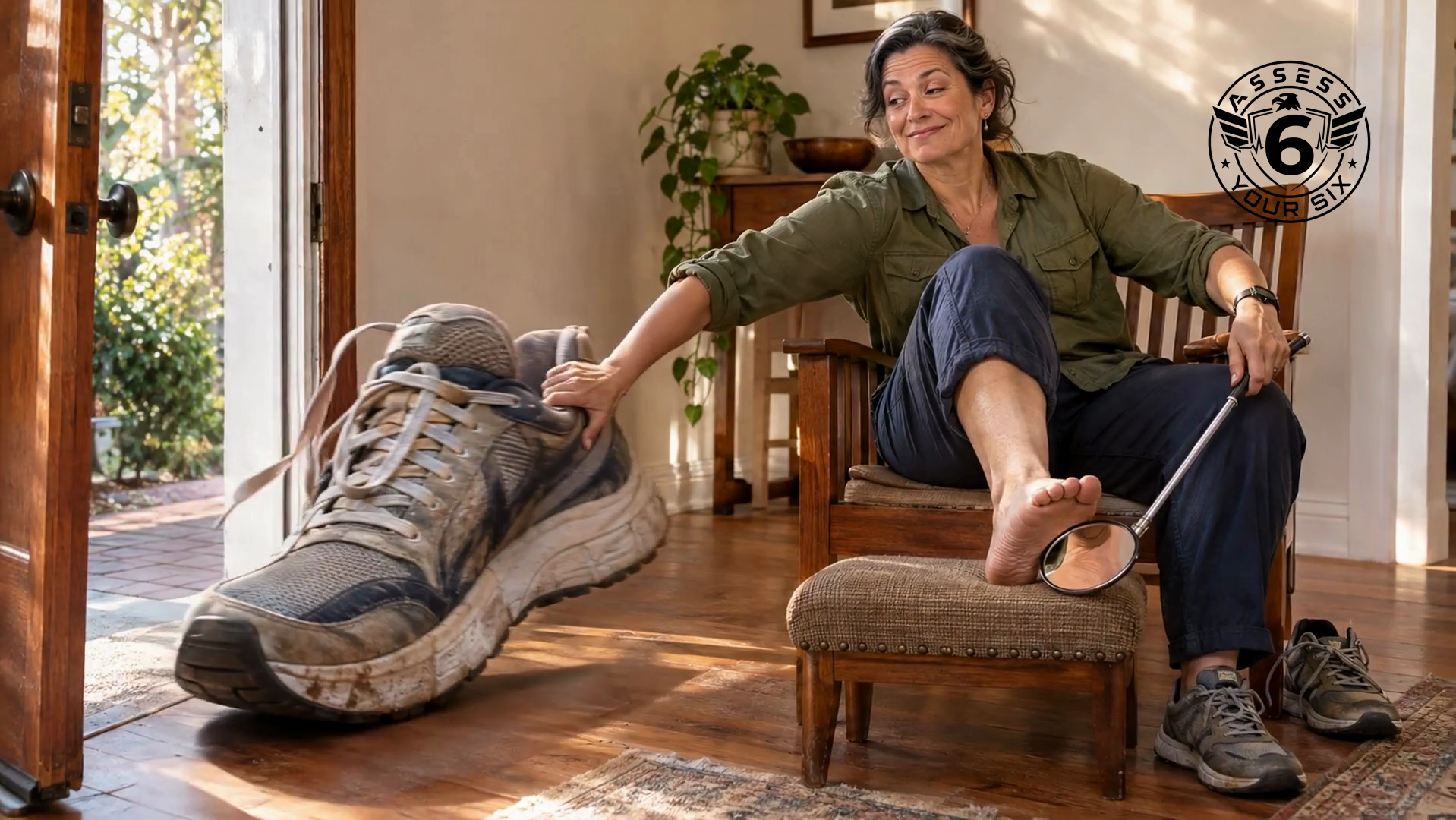
You can’t win the race tryin’ to run in somebody else’s shoes.
Especially when his shoes come with a step goal, a victory dance and no idea what is happening inside yours. Your buddy hit his number before breakfast. Wonderful. Give the man his confetti. If you are a Veteran with diabetes, I want to know who checked your feet before we start handing out medals.
We have gotten good at celebrating what a watch can count. We can also get careless about what that number never promised to tell us. Steps taken? Sure. Whether you have a blister you cannot feel? Different question. Same feet. A less entertaining notification, apparently, but one worth discussing with your VA care team.
“Doesn’t Hurt” Is Doing a Lot of Unpaid Work Here
Diabetes can damage nerves and reduce feeling in your feet. It can also affect circulation and healing. So an injury may not hurt the way you expect, and healing may be harder. That is the trouble with “I’d know if something was wrong.” You may be asking a warning system with a known limitation to swear everything is fine.
C’mon now. We inspect a tire before trusting it on the highway, but a foot gets waved through because it is not complaining? I am not diagnosing your feet from over here. I am questioning the inspection procedure. If pain is the only thing that gets your attention, ask your clinician whether you can rely on it for that job.
VA recommends daily foot checks, with a mirror or help when needed, and regular professional checks on your care team’s schedule. Look for changes such as redness, swelling, blisters or breaks in the skin. Those are separate jobs from counting steps. The watch can celebrate your walk without having examined one square inch of what carried you through it.
And needing help does not make you less independent. If checking your sole requires folding yourself like a lawn chair, tell the team. Ask how to make the check workable. A woman Veteran can walk her dog and still struggle to see the bottom of her foot. Her step total has not solved that problem. Tell the team what gets in the way.
Now Give the Technology a Useful Assignment
I would rather start with “What are we trying to notice?” than “Which gadget should I buy?” If your problem is an injury you might not feel, a more enthusiastic step reminder has not answered it. Keep following your clinician’s activity advice. Just do not let somebody else’s target become your foot care plan because it arrived with a prettier screen.
There are tools aimed at a different question. NIDDK says a clinician may recommend skin temperature checks for people with certain foot problems that increase their risk of a sore. A hot spot can be an early sign of a developing blister or ulcer. That earns a specific conversation with your team, not a shopping spree or a diagnosis from the couch.
VA lists a funded study of home foot temperature monitoring through smart mat technology for patients with diabetes at high risk. The listed project runs from January 2023 through September 2027. A mat is a home device, not a wearable. I want us paying attention to that distinction: the useful tool might belong under your feet instead of on your wrist.
HOW FREAKING EVER, a research listing is not a results paper. It does not prove a device prevents an amputation, establish what is available at your local VA or put your name on a delivery box. Possibility does not get to borrow a lab coat and introduce itself as proof. Let’s be interested enough to follow the research and honest enough to leave the unanswered questions unanswered.
Now put that promising tool in your actual house. The nice person demonstrating it has gone home. Can you actually use it comfortably? Who explains an unusual result? What happens when the thing quits connecting? That is where I want the explanation to get specific. A good demonstration should leave you understanding the work, not wondering whether the demonstrator comes with the box.
PRO MOVE: Make the Appointment About Your Feet
Try this with your VA primary care or diabetes team: “What is my foot risk, what should I check every day, and do I need a podiatry assessment?” Then ask whether any home monitoring tool fits your situation. Notice we have not named a brand. We are giving the team a problem to help solve before we arrive emotionally attached to the box.
Bring the awkward details, too. You cannot reach. You cannot see the sole clearly. The mirror suggestion sounds fine until you try it. Say so. “I understand the instructions, but I cannot do that at home” is useful information. Nodding politely and going home with an impossible assignment does not improve the assignment. Ask about help you can realistically arrange.
At the visit, ask the team to explain what your examination says about feeling and circulation, in words you can repeat at home. “My feet are fine” and “I know my risk and what to watch for” are not the same answer. If you do not understand a term, stop them and ask for a clear explanation. You are there to leave with a usable plan, not collect a vocabulary list. A polite nod is a terrible way to discover later that you misunderstood the assignment.
If a device enters the plan, ask what it measures, what it can miss and what you should do with an alert. Find out who, if anyone, reviews the information and when. Wireless means it can communicate. It does not mean somebody at VA has pulled up a chair and started watching your feet. Get the actual arrangement explained before you count on it.
Then get the contact instructions straight: which changes need attention, whom to contact and what to do when the usual office is closed. Write it down or ask for it in writing. “Keep an eye on it” leaves an awful lot of room for interpretation. Your feet deserve better than a plan that depends on guessing what somebody meant three days later.
The Next Appointment Is Not Permission to Wait
CDC advises seeing your clinician right away for concerning changes, including changes in foot color or temperature, rather than waiting for the next appointment. Follow your care team’s instructions for prompt help. “But I hit my step goal” is not a reason to postpone getting a new foot problem assessed, even if it does not hurt.
You do not need a smartwatch to ask these questions, and you do not need to win an argument with a fitness app. You need your own risk explained, a check you can manage and a clear route to help. That is a perfectly respectable set of goals. It just does not throw confetti when you finish.
Veterans, which part needs clearing up at your next VA visit: your risk, the daily check or whom to contact? Let your buddy have his leaderboard. We are trying to keep you on your own two feet, in a plan that fits your life. Somebody else’s shoes have already taken up enough room.
What Industry and VA Programs Need to Prove
The same practical test belongs in every connected health proposal. What Veteran problem is the tool expected to notice? Who is the intended user? Can that person use it at home? What does the device measure directly, and what can it miss? Who receives an unusual result, what is the response window, and what does the Veteran do when the usual contact is unavailable?
My Guy, “the data goes to the cloud” is not a clinical workflow. A product can collect information beautifully and still leave the useful part of the job unemployed. The Veteran needs a workable care plan. VA needs evidence, ownership, capacity and a support path. Industry needs to prove that the tool fits those realities before the demonstration music starts.
Companies, does your device solve a defined Veteran problem, or is it another screen asking for attention? VA teams and clinicians, which barrier keeps the daily plan from working at home: visibility, reach, support, connectivity, response ownership or the ability to sustain the service?
JhetVet® helps medical device and health technology companies test the Veteran use case, evidence, VA stakeholder map, purchasing path, support model and field execution before a connected device is asked to do a job the workflow never assigned.
See how JhetVet® supports wearable health companies, review how we operate, or start the conversation.
Sources
National Institute of Diabetes and Digestive and Kidney Diseases: Diabetes and Foot Problems
VA Office of Research and Development funded project I01HX003540 01A1
Centers for Disease Control and Prevention: Your Feet and Diabetes
This Article provides educational information and questions for discussion with a healthcare professional. It does not diagnose a foot problem, recommend a specific device, establish local VA availability or replace an individual care plan.